CI gates
A gate is one verdict on one agent for one candidate build: does every promoted production failure stay fixed, and does every enabled scenario still pass? It runs in CI through the GitHub Action and the CLI; this page is where the runs live.
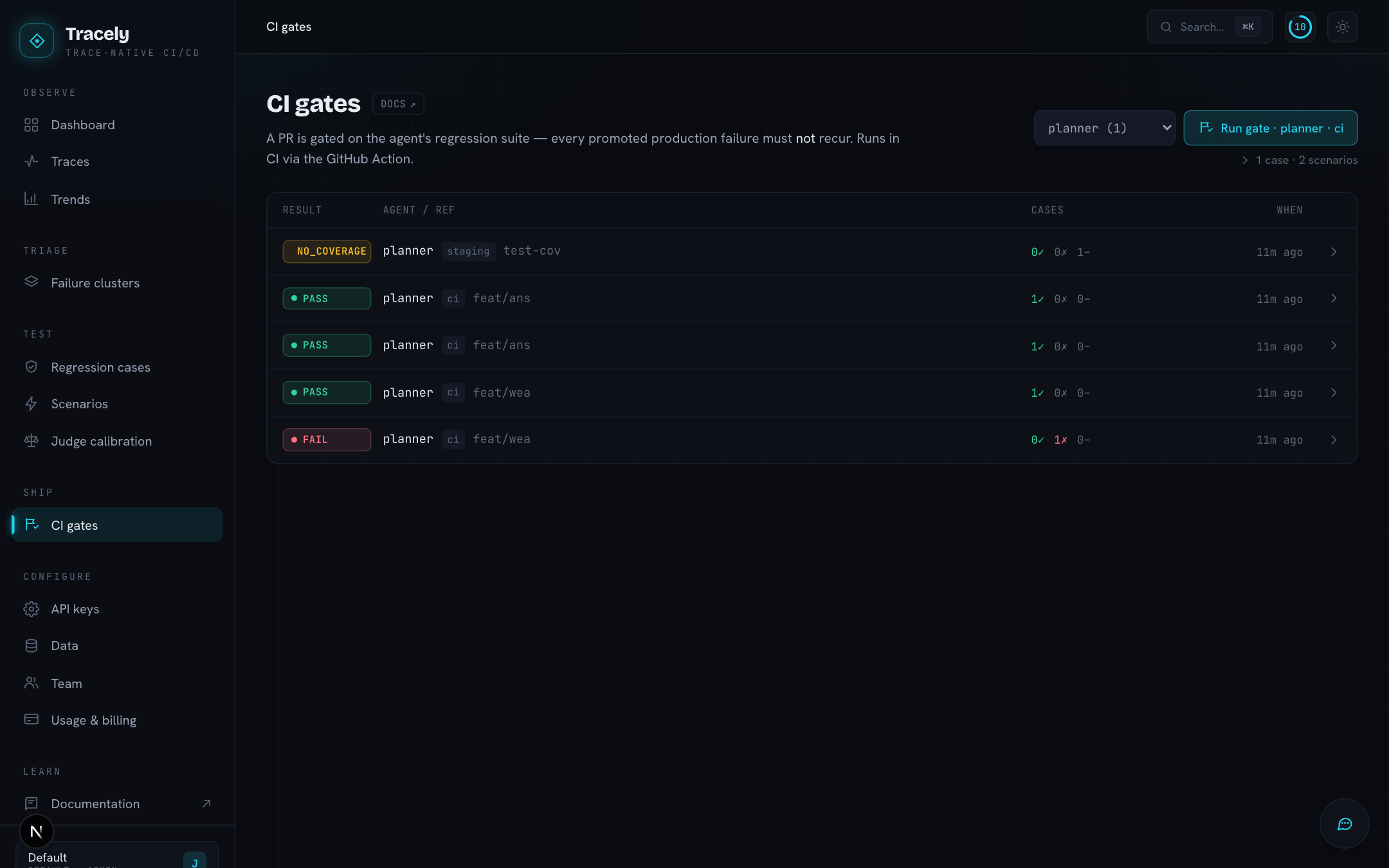
The list
Per run: the result, the agent, the environment and git ref / PR it was about, passed / failed / skipped counts, and any soft warnings.
Run gate
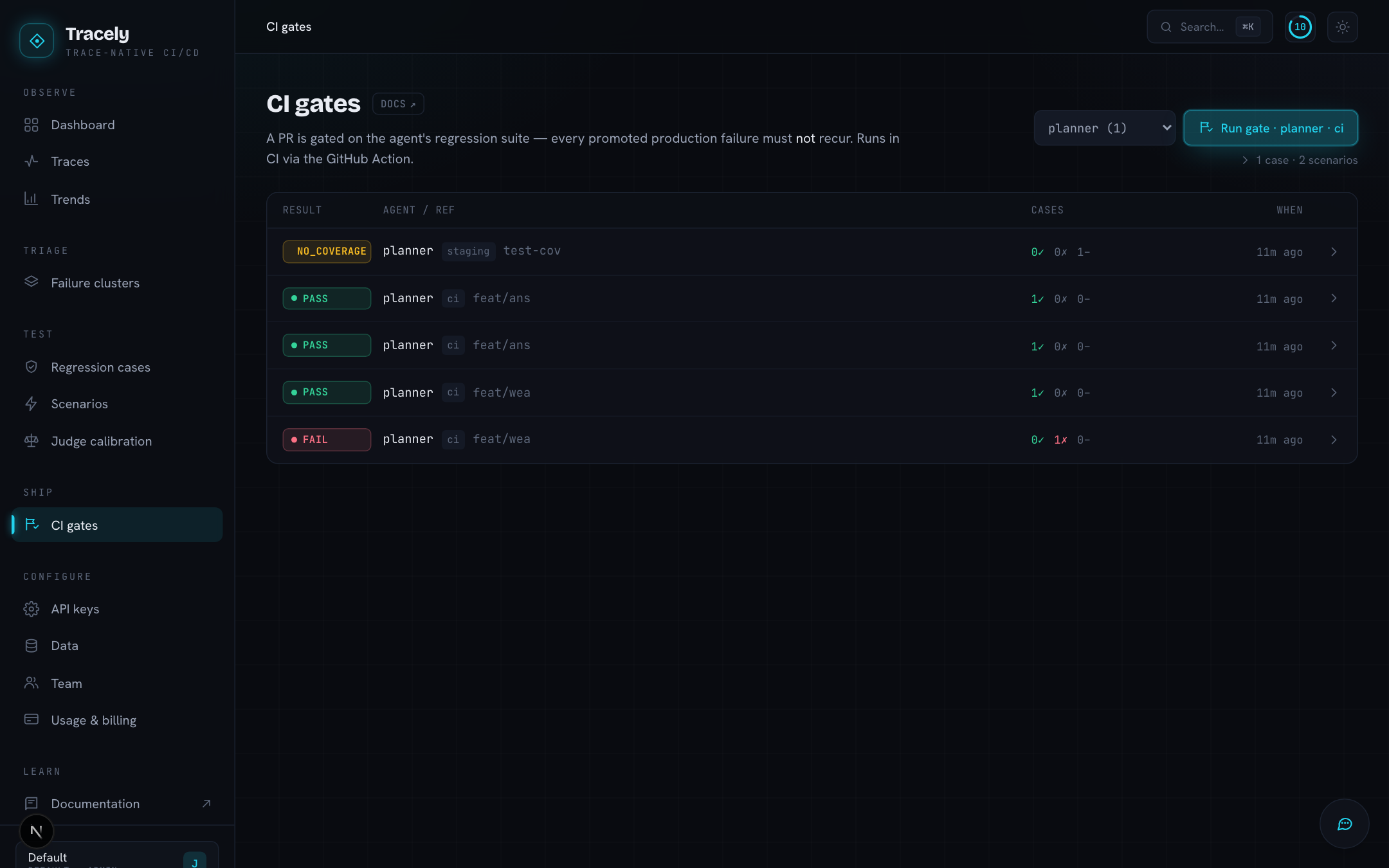
Pick the agent to gate (the picker is ranked by how many promoted cases each agent has; the line under the button says what will run — 1 case · 2 scenarios) and click Run gate. The run starts immediately and the list refreshes as it finishes. Cases are evaluated against the latest env=ci traces for that agent (a CI run is matched to its case by the digest of the input, or paired explicitly by tracely replay); scenarios are driven at the registered endpoint.
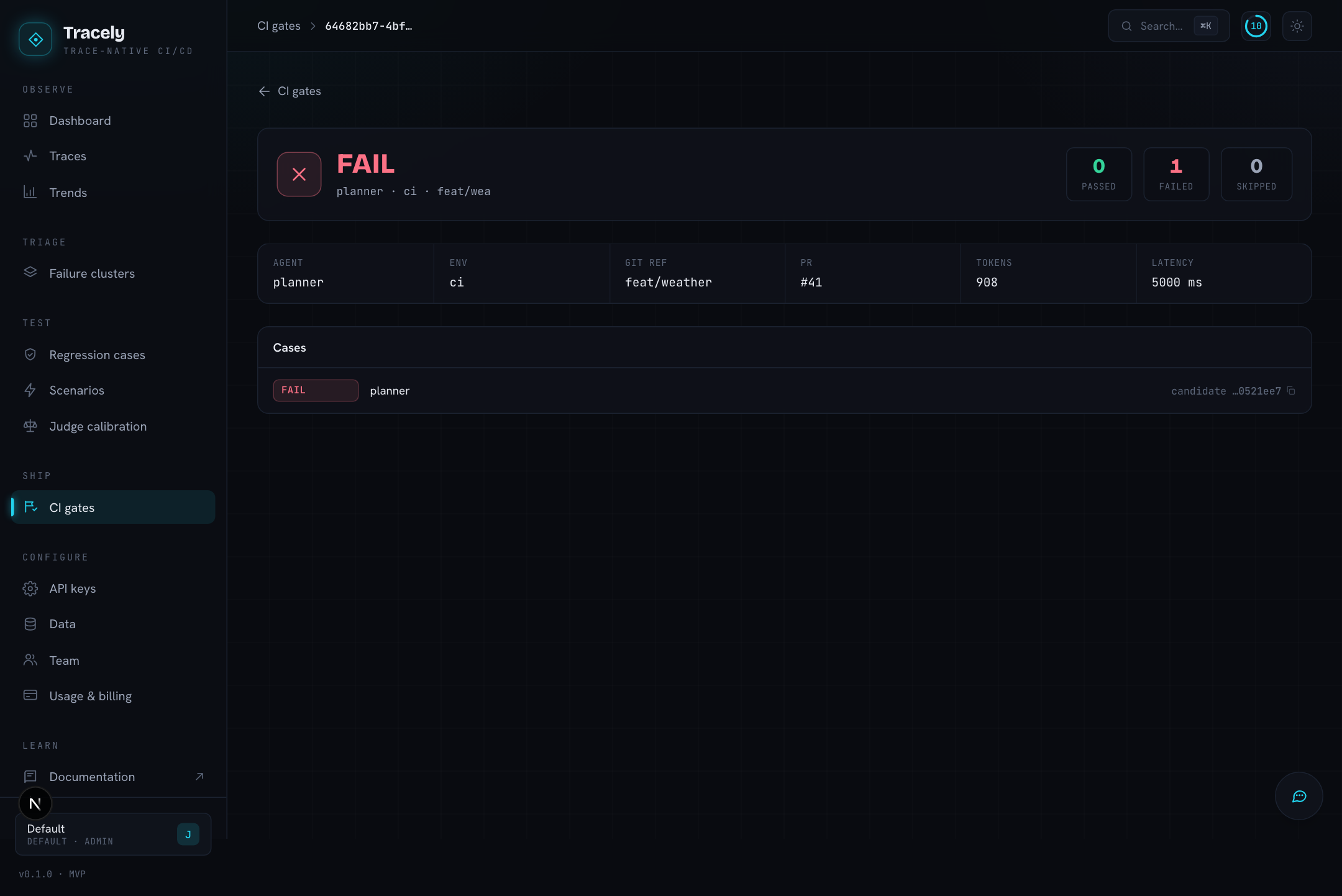
A gate run
-
Status banner —
Status Meaning PASS every case and scenario passed FAIL at least one production failure recurred, or a scenario failed NO_COVERAGE no candidate trace matched a case — the gate could not check anything, and says so instead of going green INCOMPLETE a case ran but could not be fully checked: a required judge returned no result (no LLM key, judge disabled) or the recorded replay did not complete. Nothing failed, nothing was shown to pass UNGRADED a conversation produced no gradeable scores NO_COVERAGE,INCOMPLETEandUNGRADEDblock the merge exactly likeFAIL: an empty or half-checked gate is not a passed gate.Each run records its execution manifest: the run id that produced the candidates (every trace the CLI emitted is stamped with it), the execution mode, and per case the pairing strategy —
run(this execution’s trace, the only pairing that verifies a candidate),explicit-unscoped, ordigest-fallback(the latest trace with the same input, used when no run id was supplied; the run carries a warning). A candidate that is not this run’s, has a different input, was not found, or whose command failed isINCOMPLETEwith that reason.Every case verdict is built from named checks —
tools,no_error, and onequality:<judge>per judge the case was promoted from — each required or advisory, eachPASS/FAIL/UNAVAILABLE, plus the execution evidence (mode, completed, divergence). A case isPASSonly when every required check ran and passed under a completed execution; a required check that is unavailable makes itINCOMPLETE; a requiredFAILisFAIL. Advisory checks stay visible and never decide. The same contract grades the manual Replay on a case page, so the UI, the CLI and CI cannot disagree about one candidate. -
Warnings — the candidate’s latency and token usage are compared with the last green gate for the same agent; a regression beyond 25 % is a warning. Warnings are non-blocking unless the gate is configured to block on them. Fail-to-pass is the only hard rule.
-
Score drops (scenario gates) — each evaluator’s mean score is compared, scenario by scenario, with the conversations of the last green gate. A drop of 0.1 or more is a warning (
score drop: goal_success -0.22 vs last green gate …); runtracely simulate --max-score-drop 0.1and it fails the gate, even when every conversation passed. -
Cases — one row per case: verdict, the candidate trace it was checked against (click through to the trace), and the assertion that failed.
In CI
# .github/workflows/tracely-gate.yml — the two common shapes
- run: tracely replay planner --entrypoint weather_agent:run   # re-run the agent on its cases, hermetically
- run: tracely simulate --all                                   # drive every enabled scenario at the staging endpoint
Each command posts a commit status and a PR comment and exits non-zero on anything but PASS. The CI gate CLI page covers flags, --env, and the Action.
The gate is deliberately a fail-to-pass check on real production failures, not a score threshold: a release is blocked because a specific thing that broke last Tuesday would break again, and the comment on the PR names it.
Want it in Slack as well as on the PR — including the run that could not execute at all? Alerts fire on FAIL and on NO_COVERAGE.