Judge calibration
Before an LLM judge is allowed to block a merge, check it against yourself. Calibration is a labelling queue: you grade a run first, the judge’s verdict is revealed after, and Tracely keeps score per evaluator.
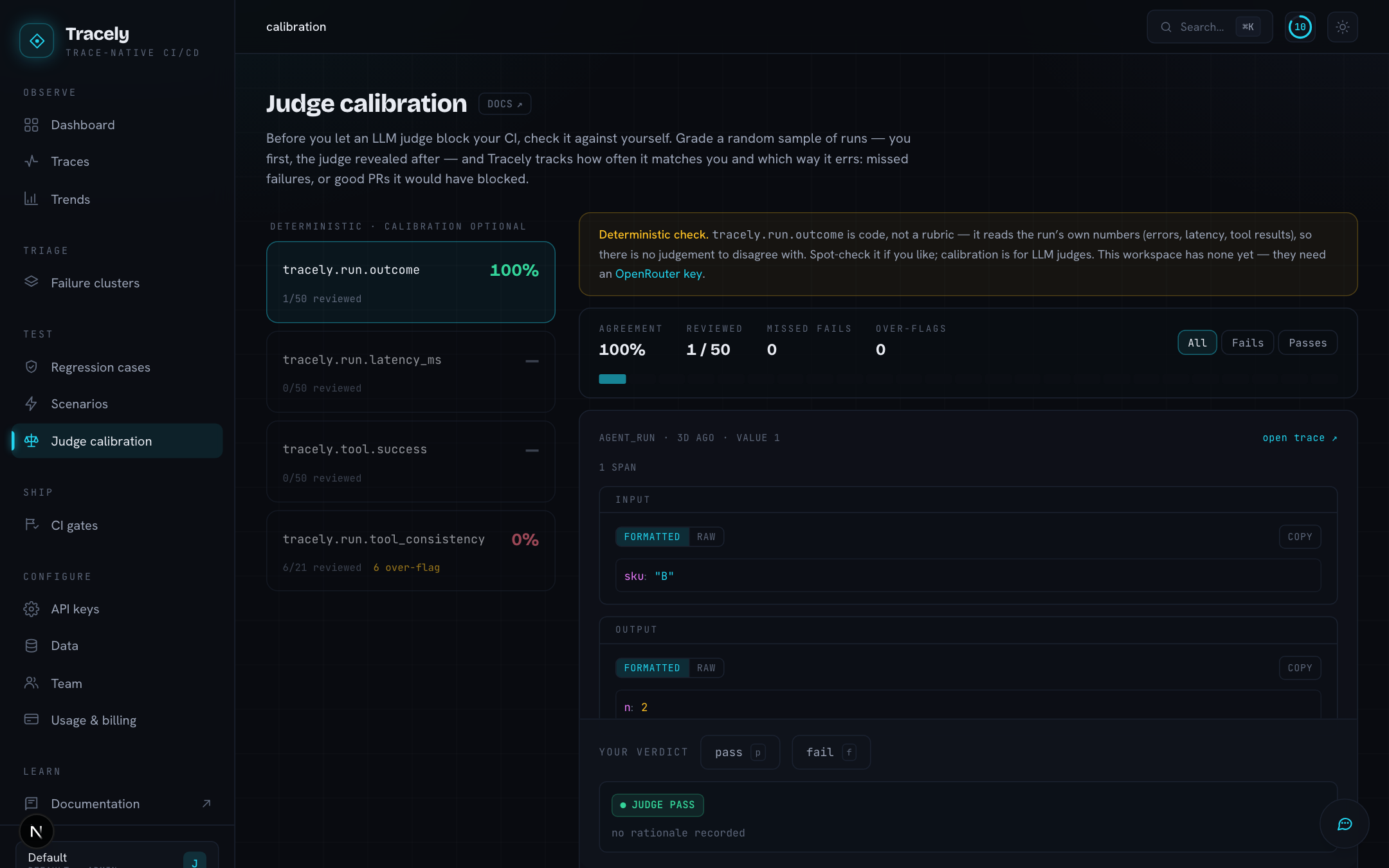
The cards
One per judge column:
| Number | Meaning |
|---|---|
| Agreement | share of your labels where the judge said the same thing — green from 80 %, amber from 50 %, red below |
| Reviewed | how many of its recent verdicts you have labelled |
| Missed fails | you said FAIL, the judge did not — the dangerous direction: a gate built on this judge would let that failure ship |
| Over-flags | the judge said FAIL, you did not — the annoying direction: good PRs it would have blocked |
The queue
Recent judge decisions for the selected evaluator, newest first, each with the judge’s verdict, its rationale, the run’s input and output, and a link to the trace. ✓ agree records your label as the judge’s verdict; ✗ disagree records the opposite; clicking the active one again clears it. Labels are per reviewer, one per score, and the summary updates as you go.
Labels are kept with a snapshot of the judge’s verdict at the time, so re-running the column later does not rewrite history.
Calibration needs an LLM judge to calibrate. With no OpenRouter key configured the page points you to Settings → API keys.
What to do with a bad number: tighten the rubric (the Add Column form edits a live column), switch the level (a step judge sees far less than a message judge), or mark the column advisory until it agrees with you.