Regression cases
A case is a production trace that must never recur. You do not write it; you promote it — from a failing trace, or from a failure cluster — and from then on every CI gate for that agent replays it.
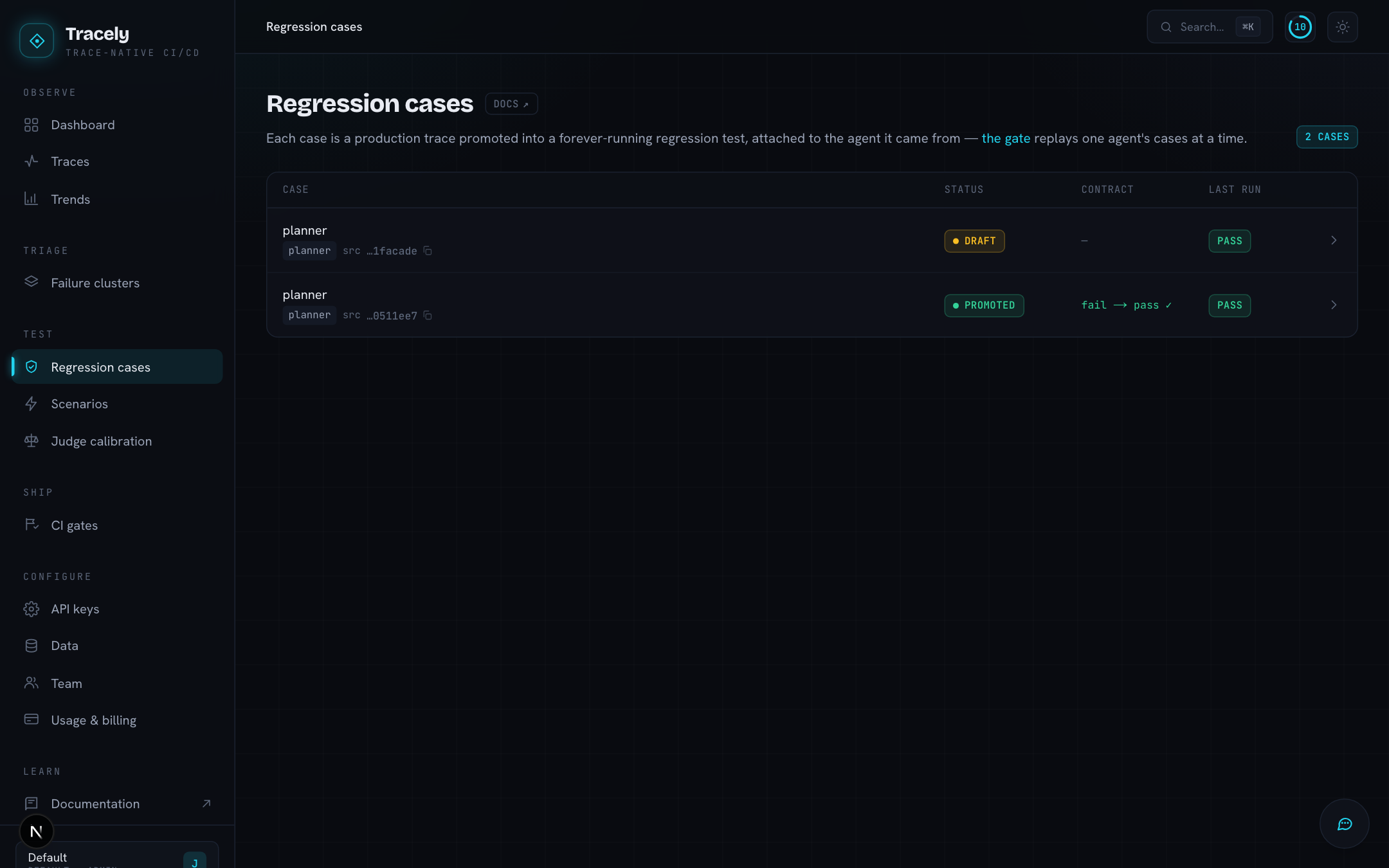
What promoting captures
- The input — the user request exactly as it arrived, plus a digest of it so the same input is never promoted twice and a CI run can be matched to its case without any wiring.
- A fixture bundle — every tool call and model call the run made, in order, with arguments, outputs and error status, stored in object storage. This is what makes hermetic replay possible: in CI the agent’s code runs for real, but its tools and model calls are served from the recording.
- Lifecycle evidence, kept apart. A case page shows separate facts, never one “protected” badge: source failure confirmed (the source trace fails the contract — the bug is reproduced), candidate verified · vN (a specific candidate execution passed the contract at case version N, from a run-scoped CI gate or a manual replay of a candidate trace — replaying the source never counts), and, when the contract has changed since, verified against vN — re-verify. Suite inclusion and repository branch protection are separate facts again, shown on the gate.
- A durable artifact — one versioned snapshot per case version holding the executable input, the fixture bundle, the expectations (assertions + match mode), the identity of every judge the case expects (evaluator id, config digest, model) and provenance (source trace, agent version, input digest, captured-at), with a content digest pinned on the case and on every gate result graded against it. This is what keeps a case executable after its source trace has aged out of retention. External state (a database row, a ticket) is not captured; the artifact says so rather than pretending to be self-contained. Cases promoted before artifacts existed are snapshotted by a nightly backfill while their source still exists; one whose source already expired shows not snapshotted and needs a recapture (
POST /api/cases/{id}/recapturewith a fresh trace of the same input, which bumps the case version). Deleting a case is the only thing that deletes its artifact and bundle. - The reference trajectory — the ordered list of steps the failing run took.
- A fail-to-pass contract — the assertions a candidate run must satisfy: no run error; the tools the agent was asked for and must actually execute; whether the tool sequence must match; whether a tool error is tolerated when the agent handles it gracefully.
Then the contract is validated against the source trace: the failing run must fail its own case. A case the original failure would pass is not a regression test, and Tracely refuses to create it.
Statuses
| Status | Meaning |
|---|---|
| DRAFT | promoted, not yet part of the gate |
| PROMOTED | replayed by every gate for this agent |
| QUARANTINED | set aside — flaky or superseded; ignored by the gate |
| UNREPRODUCIBLE | the fixture could not be replayed |
A case
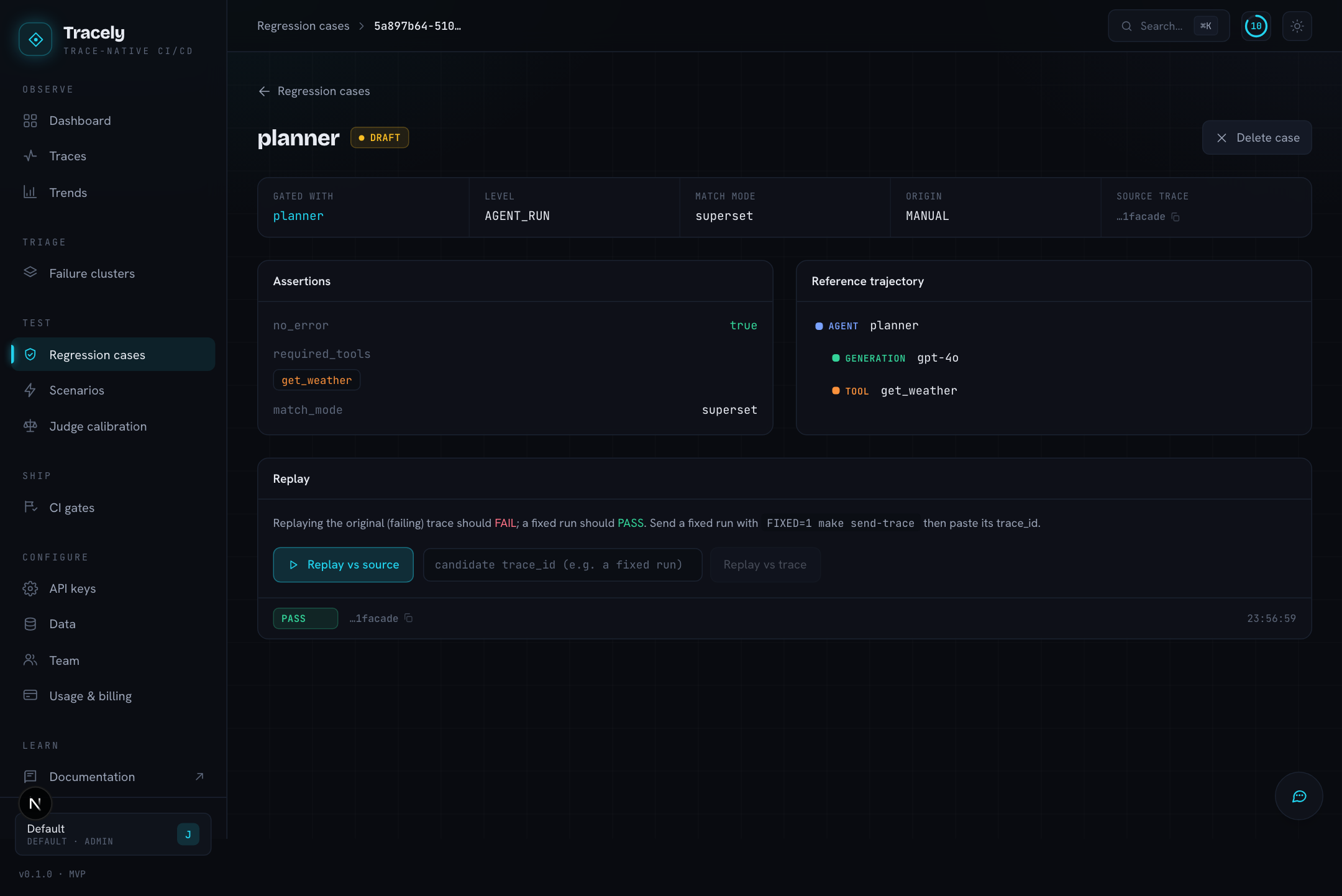
The case page is the failure-to-fix workspace: seven numbered sections, top to bottom, so a developer answers the five questions without assembling them across screens.
- What went wrong — agent, source trace, whether a test exists (in the suite or draft), and how the original fails the contract, check by check.
- What the agent should have done — the expectations in plain language (“Must call
lookup…”, “Must never call …”, “lookupmust be called with order_id = “42""), backed by an editor: required and forbidden tools, match mode, error-handling expectations, and under Advanced call bounds and argument predicates. Saving creates the next case version, re-snapshots the artifact and re-checks that the original still fails — a case whose original now passes goes back to DRAFT and says so. The recorded arguments are never copied into the contract for you: a failure trace is evidence of the bug, not the expected behaviour. - Reproduce it — the execution mode (recorded tools + recorded model), fixture readiness, and a copyable
tracely replay <agent> --entrypoint … --case <id>for this case, with what recorded replay does and does not establish. - Pick the run to check — the exact compatible candidates (runs of this agent with this input), newest first, each with its env, run id and prior verdict; Verify grades one through the same contract CI applies. Pasting a trace id is the advanced path.
- Original vs candidate — the relevant steps aligned side by side (stacked on narrow screens): tool by tool, arguments and results, with the first meaningful divergence named; both answers below.
- What the check established — the evidence receipt: verdict, case version, artifact digest, execution mode, every check with its status, the judge identity, and one sentence on what this does and does not prove.
- Next — in the suite or not, the last CI verdict (linked, with its run id), and branch protection — shown as not confirmed by Tracely until you make the check required in your repository.
The reference trajectory and the full replay history sit in a collapsible strip at the bottom.
- Replay — paste the trace id of a candidate run (a fixed version of the agent, run in staging or CI) and Tracely evaluates it against the contract right here — the same contract the CI gate applies, structural checks and the answer-quality judge the case was promoted from:
FAILwhile the bug is present,PASSonce it is fixed,INCOMPLETEwhen a required check could not run (no LLM key for the judge, a replay that did not complete). Every replay is kept as history with its checks, execution mode and judge identity, so a case carries its own red → green story and a historical verdict stays explainable after the judge changes. - Source trace — the production run it came from, one click away.
In CI the same evaluation runs for every promoted case at once — that is a gate. tracely replay <agent> --entrypoint module:function re-runs your agent on each case’s input with the recorded fixtures and submits the results; tracely gate <agent> evaluates traces your CI produced on its own.